
It’s curious how the appropriate to protest seems to be totally different from reverse sides of a barricade.
Arun Jaitley, former president of the Delhi College College students’ Union, as soon as escaped an early-morning try to arrest him throughout the Emergency. He returned to campus, burned an effigy of Indira Gandhi and courted arrest. Jaitley was in good firm. The veteran Gandhian Jayaprakash Narayan’s name for Sampoorna Kranti, which began as a scholar motion and shortly turned the image of anti-Emergency resistance, was virtually a political ending college for India’s college students and future leaders. Lalu Prasad Yadav was main the Patna College College students’ Union. Scholar chief Nitish Kumar was swept into politics via the JP motion. Sitaram Yechury lower his political enamel in JNU’s politics, marching to Indira Gandhi’s residence and demanding her resignation as chancellor of the college. Sharad Yadav, president of Jabalpur College college students’ union, was backed by JP to contest a 1974 byelection — which he gained. Preventing on the opposite aspect, Mamata Banerjee, then a younger Congress activist, blocked JP’s convoy in Kolkata. She climbed onto his automobile and shouted slogans.
Prime Minister Narendra Modi, too, had his political apprenticeship in a mass motion. Then an RSS pracharak, he joined Gujarat’s Navnirman Andolan of 1973, which started with scholar protests over rising canteen costs and grew right into a statewide agitation. The motion introduced Gujarat to a standstill. Inside weeks, chief minister Chimanbhai Patel was pressured to resign, the state meeting was dissolved, and Gujarat was positioned beneath President’s Rule. Modi’s personal web site remembers Navnirman as his introduction to mass protest, a campaign towards corruption that formed his understanding of scholar considerations. Union dwelling minister Amit Shah, too, got here up via scholar politics. He was appointed joint secretary of the Gujarat ABVP and moved into the BJP’s youth wing. He and Modi met within the RSS community in Ahmedabad. They weren’t outsiders to youth actions; they have been aligned with it.
Jaitley didn’t ask the State for permission earlier than his daredevilry. The Navnirman protesters didn’t look forward to an invite from the Gujarat police. Yechury didn’t search an appointment earlier than marching to the PM’s residence. They merely exercised their democratic proper to dissent and protest.
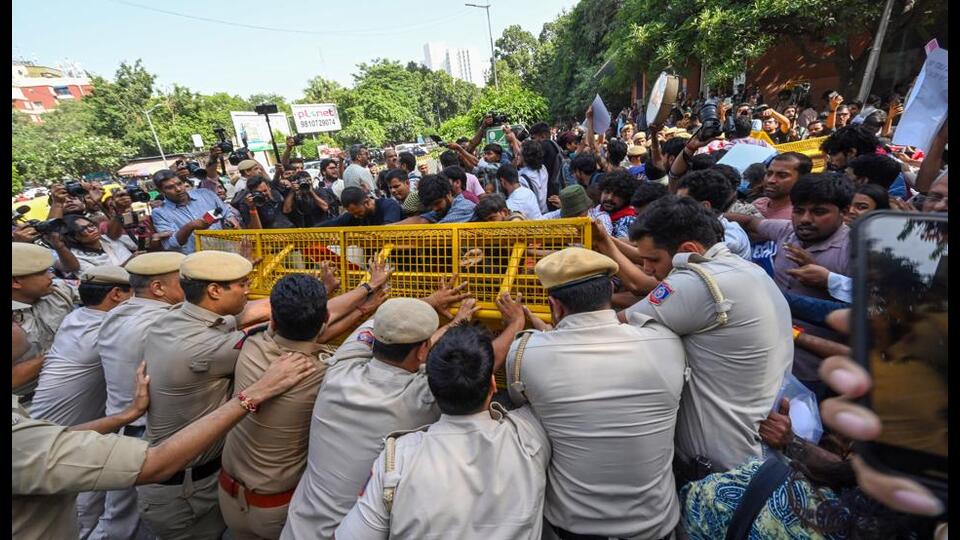
Think about the inconvenience of getting to elucidate this to a scholar at Jantar Mantar immediately. Residents demanding solutions now wrestle to train the identical proper. Stories and visuals of protesters being crushed, dragged and subjected to sexual assault by police have surfaced. Protest websites have been denotified, trains cancelled, metro stations shut, and as much as 7,000 residents detained. And what are we to make of reviews that folks have been intercepted en path to Delhi on suspicion of intention to hitch the protests? Evidently, the very best protest is the one which by no means occurs.
These endorsing dissent whereas decrying disturbance to the rhythms of on a regular basis life overlook India’s historical past of mass actions. From strikes to highway blockades, earlier protests have been typically disruptive by design to compel political motion. Gujarat’s Navnirman, particularly, was marred by arson, assaults on police, strikes, and destruction of public property. Ahmedabad had descended into near-anarchy earlier than the military was known as in.
The anti-CAA protests, against this, noticed largely peaceable sit-ins, with ladies sustaining a months-long protest. Right this moment, these demanding accountability from the Election Fee and Chief Election Commissioner Gyanesh Kumar have confronted disproportionate pressure by the police and state equipment; but they show exceptional restraint and proceed to insist on peaceable means. From the anti-CAA protests to these towards the NEET-leaks and the CEC, demonstrators have invoked Gandhi, Ambedkar and the Structure, making seen their dedication to peace and civic restraint. They know that the mechanisms of protest via which immediately’s leaders got here of age could immediately be framed as disruptions to public order.
Residents ought to be capable to belief the method that elects their authorities. When they’re pushed to the streets over fears in regards to the integrity of the electoral course of and their proper to vote, any democracy ought to take pause. However yesterday’s rebels have develop into immediately’s leaders, and people who as soon as knew the worth of a avenue stuffed with dissenting college students now appear far much less persuaded by it. They need to keep in mind that the scholars outdoors the barricades are asking for a similar democracy they as soon as demanded for themselves. It shouldn’t be so troublesome to recollect.
Insiyah Vahanvaty is a socio-political commentator and Writer of ‘The Fearless Choose’. Ashish Bharadwaj writes on larger training, expertise, and patents. The views expressed are private
